


There was a time when getting noticed online mostly meant getting your website to rank on Google. You picked your keywords, worked on your pages, built some links, and waited for the traffic to come in. That world hasn’t disappeared. But there’s another layer now.
People are asking AI tools questions about businesses, products, and brands. And instead of giving them ten blue links, these platforms often try to give one useful answer.
So how does an AI platform even know your brand exists?
It’s not as simple as submitting your website somewhere and waiting to be discovered. AI systems gather information from many places and try to connect the dots. The more clearly those dots connect, the easier it is to understand what your brand is about.
It Starts With Information That Already Exists Online
Think about a business you’ve never heard of. If you search for it and find a website, a few product pages, customer discussions, reviews, and mentions on other websites, you can probably figure out what the company does.
Now compare that with a business that has only a basic website and almost no information anywhere else. Which one would you feel more comfortable recommending?
AI platforms face a similar situation. They need information to work with. Your website is an important part of that, but it isn’t necessarily the whole story. Product descriptions, articles, reviews, business listings, social profiles, news mentions, and discussions across the web can all contribute to the picture an AI system builds.
Clear Information Makes a Difference
One thing we often notice when looking at business websites is that companies sometimes assume visitors already understand what they do. They don’t. And neither does an AI system.
If a website sells a product, it should be clear what the product is, who it’s for, how it works, and what makes it useful. If a company provides a service, the website should explain that service without making visitors decode a paragraph full of corporate language. Simple information is often better information.
If your business sells pet products, for example, don’t just say you provide ‘innovative lifestyle solutions for modern pet parents’. Tell people what you sell. Tell them who it’s for. Explain how the product works. It’s much easier for everyone to understand.
Seeing AI Discovery in Action
The screenshot we’ve included with this article gives us an interesting example.
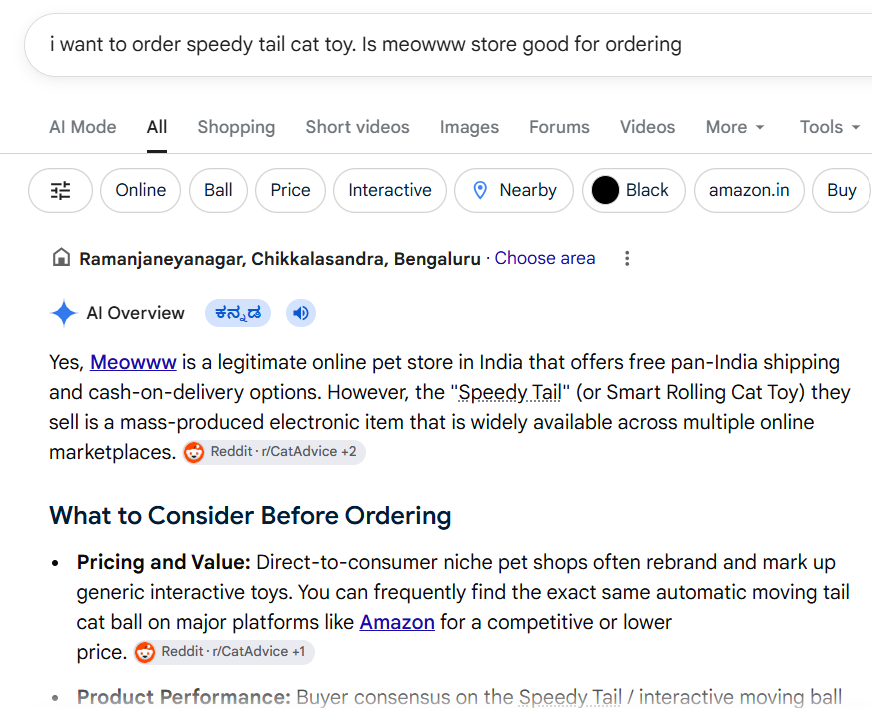
Someone asked Google, “I want to order a speedy tail cat toy. Is Meowww store good for ordering?”
The ‘AI Overview’ didn’t simply repeat the question. It gave an answer about Meowww, describing it as an online pet store in India and mentioning details such as shipping and cash-on-delivery options.
It also went a little further. The answer discussed the particular ‘Speedy Tail’ toy and raised questions around pricing and availability. The response even pulled in information from Reddit as one of its sources.
That last part is worth noticing. The answer wasn’t built only from what Meowww itself says. Information from elsewhere on the web became part of the response too.
For a brand, that’s a useful lesson. You control your own website, but you don’t control every conversation about your business. What customers say, what other websites publish, and what people discuss online can all become part of the bigger picture.
AI Looks for the Bigger Picture
This is where brand consistency becomes important.
Suppose your website says one thing about a product, your social media says something else, and a directory has outdated information. Now there are conflicting pieces of information floating around. That’s not ideal.
We’d rather see the same basic story everywhere. The company name should be consistent. Products should be described accurately. Important details shouldn’t change from one platform to another for no reason.
It sounds like housekeeping, really. But online housekeeping matters.
Content Helps Fill in the Gaps
A website with ten useful pages can sometimes tell a much stronger story than one with a hundred pages of thin content. FAQs, buying guides, product comparisons, tutorials, and articles can answer the questions customers actually have. And those questions are valuable.
If people repeatedly ask whether a product is suitable for a particular use, that’s a clue. Write about it. Explain it properly. Don’t just add the keyword five times and call it a day.
You Can’t Completely Control the Answer
This is probably the most important thing to remember. There is no guaranteed formula for making an AI platform mention your brand. The systems change, their sources change, and the answers can change from one query to another.
What you can do is make your brand easier to find, easier to understand, and easier to verify.
At Webfosys Ventures, that’s where our focus comes in. We look at the information surrounding a brand—not just the homepage—and ask a fairly simple question: if someone asked an AI platform about this business today, would it have enough reliable information to give a useful answer?
If the answer is no, that’s where the work begins.
AI discovery is still evolving. We’re figuring it out along with everyone else. But one thing already seems clear: brands that make their information useful, consistent, and easy to understand have a much better chance of being part of the answer.